
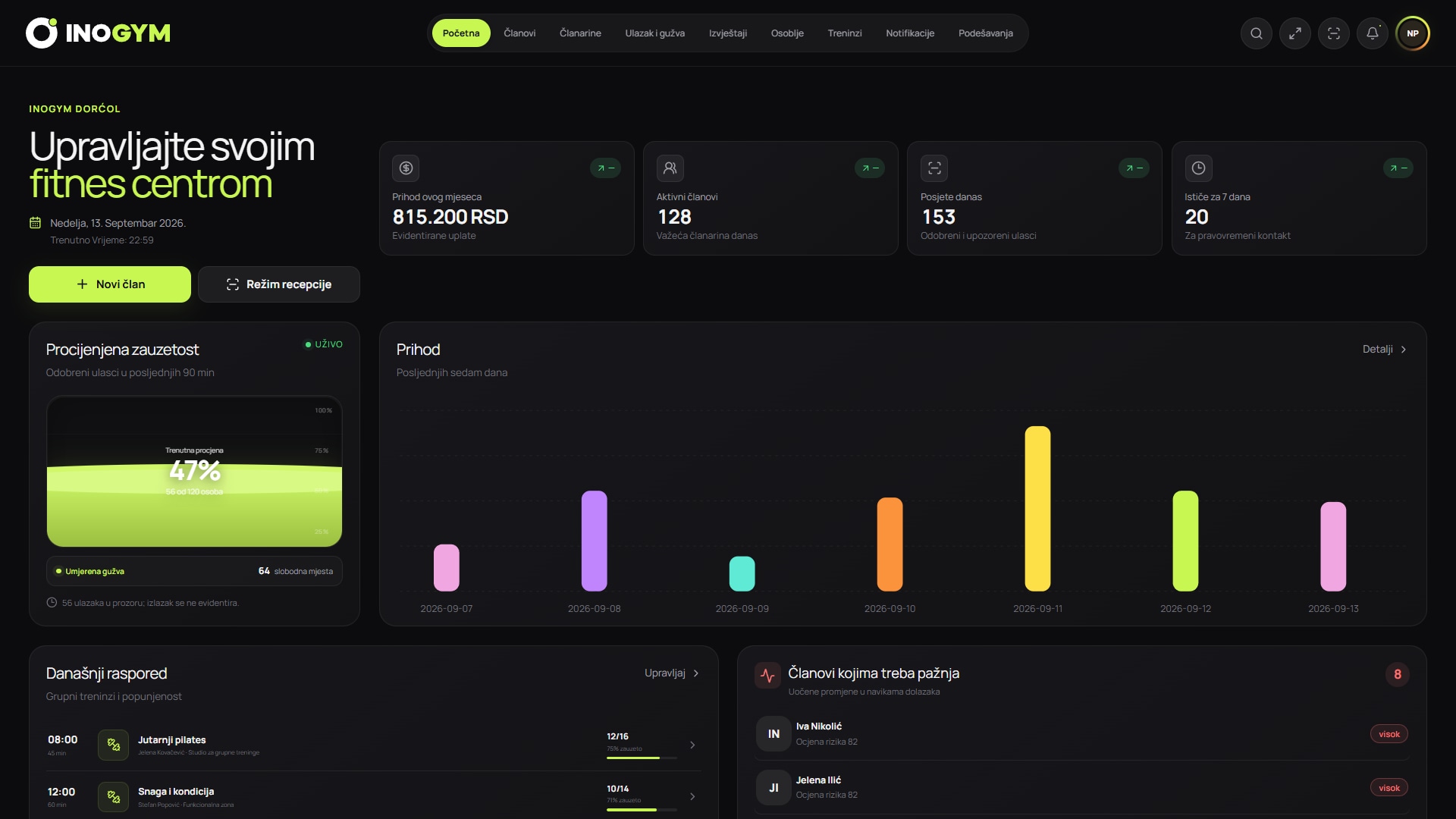
Screenshots show the Serbian version of the app.
Before starting: what must be known
A 30-day schedule is realistic only with an available decision-maker, data contact, technical entry contact and reception representative. Document locations, active members, billing methods, plan types, existing equipment and critical operating periods.
Initial scope should include members, memberships, staff sign-in, entry and basic reports. Extra campaigns, advanced automation or a full sales-process redesign can follow later. A smaller scope is easier to verify but must not omit controls needed to operate the facility.
Week 1: goals, ownership and process mapping
Map the current journey from a new member's arrival to payment and entry. For each step, identify who performs it, the data used, bottlenecks and a successful outcome. Aim to remove duplicate entry and unclear responsibility rather than digitising every old habit.
Choose three to five measures: registration time, manual corrections, failed entries caused by incorrect status, system use by shift and successful daily closing. Record baseline values before the change where possible.
| Period | Main outcome | Acceptance criterion | Owner |
|---|---|---|---|
| Days 1–7 | Approved scope and process map | No unresolved critical decision | Project owner |
| Days 8–14 | Configuration and test data | Control totals and key workflows are correct | Data owner + supplier |
| Days 15–21 | Trained shifts and pilot | Scenarios pass without critical errors | Reception lead |
| Days 22–30 | Cutover and stabilisation | Agreed metrics and support are active | Project owner |
Week 2: setup and trial migration
Configure plans, durations, staff roles, locations and entry rules before the final import. Use a representative test set with active, expired and problematic members. Each error should improve a rule or setting, not just one test record.
When connecting scanners, controllers or doors, test approved and declined entry, connection failures, power outages and emergency exits with the responsible installer. A marketing demo is not a physical safety test of the facility.
Week 3: training and a controlled pilot
Train by role. Reception registers members, records payments, handles expiry and reports issues. Managers check reports, roles and audit records. Trainers use only assigned workflows. Each participant performs the task rather than only watching the screen.
Run the pilot during a representative shift with quick support available. Record each question, the step where it arose and its impact. Avoid changing several rules at once, or you will not know which change solved or caused a problem.
- an active member can enter
- an expired membership shows the expected status
- a new payment changes only the relevant record
- staff cannot see data outside their role
- a manual procedure exists for system outages
Week 4: cutover, launch and stabilisation
Announce exactly when the new system becomes the only place for data entry. Complete the final import, repeat control totals and approve the switch. Keep the old file read-only for the planned period without parallel updates.
Provide a clear support channel and daily issue review for the first three days. Separate training, data, configuration, equipment and software issues: each has a different owner and solution. Critical failures trigger the agreed rollback or manual continuity process.
Measuring results after day 30
Compare measures with the baseline and check quality, not only sign-in counts. Heavy use with many manual corrections is not success. Few errors while half the team still uses a parallel spreadsheet does not mean the transition is complete.
Decide what becomes standard practice, what needs more training and which features enter phase two. Apply the same approach to each new automation: owner, expected outcome, tests, limits and monitoring.
When 30 days is unrealistic
Multiple locations with different rules, inconsistent data sources, equipment procurement, building work for entry controls or contract review can extend the project. Do not hide open risks to protect a deadline.
Keep the same sequence but extend phases or launch one location at a time. Acceptance criteria matter more than dates: go live when critical workflows are verified, data reconciled and staff ready.