
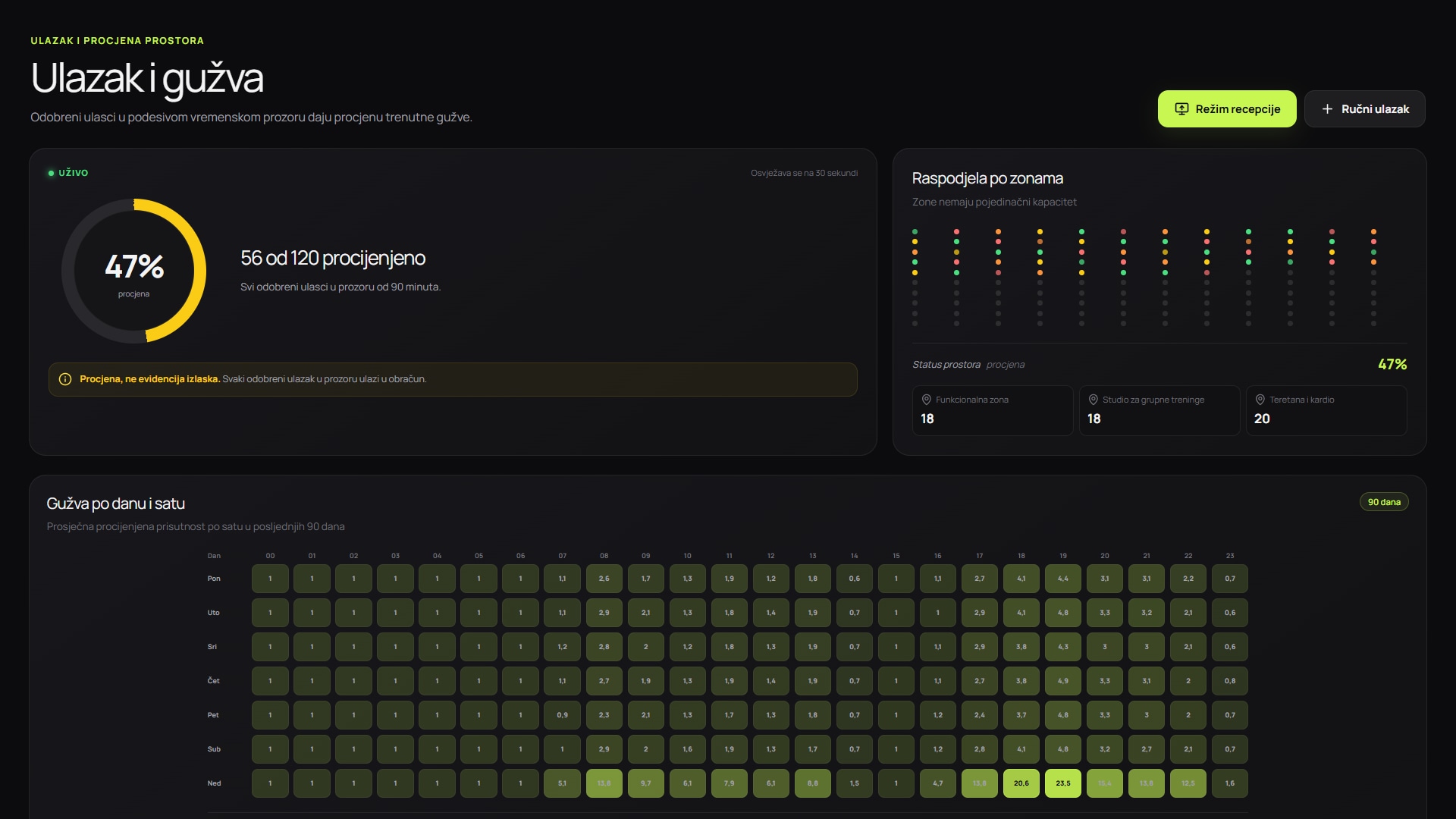
Screenshots show the Serbian version of the app.
Three capacities to keep separate
The physical or regulatory maximum comes from the space, exits and relevant expert assessment. Operational capacity may be lower because of equipment, training quality or staffing. Commercial targets describe desired use but must not raise the safety limit.
Document who approved each value and when it will be reviewed. Equipment layout, zone use or class format changes may need a new assessment. The system only uses the approved denominator.
| Metric | Formula | Data required | Main limitation |
|---|---|---|---|
| Class utilisation | actual attendees / approved places | check-ins per class | does not measure class quality |
| Booking occupancy | bookings / approved places | state before the start | does not subtract no-shows |
| Concurrent attendance | people present in the interval | entries and exits or a reliable model | entries without exits overestimate presence |
| Zone utilisation | zone attendance / operational capacity | reliable zone-level signal | QR at the main entrance is not enough |
Choose the unit, interval and source
Entries per 30 minutes may be enough for staffing decisions. Current occupancy needs a headcount, requiring exits or a verifiable duration model. A daily total does not describe peak concurrent crowding.
Document time zone, rounding and treatment of re-entry, staff, guests and failed scans. Mark changes in definitions so a methodological change is not mistaken for a trend.
Check entry record quality
Compare system counts with manual observation in predefined intervals. Check missed scans, several people entering together, unrecorded exits and reception handling of members without phones.
Do not adjust percentages with arbitrary guesses. Mark the interval incomplete, explain its limits and fix the cause. Input quality matters more than chart complexity.
Measuring group classes
For each session, retain the capacity approved that day, bookings, timely cancellations, no-shows and attendance. If capacity changes later, keep the historical denominator unchanged.
Compare the same formats, days and approximate times across several weeks. A waiting list with strong attendance is a different signal from fully booked classes with many no-shows.
From percentages to operational decisions
Set review thresholds for each indicator, rather than automatic decisions. Repeated peak attendance can trigger a review of shifts, communication and scheduling. Low class utilisation should prompt discussion of timing, format and trainers before cancellation.
Change one or a few things, record the date and track the same indicator. Changing pricing, schedules, campaigns and capacity together makes it impossible to tell which contributed to the result.
Privacy and aggregation
Operational charts often do not need member names. Use totals over sufficiently broad intervals, restrict raw-event access and align retention with a documented purpose. Public reporting needs stricter thresholds than internal operations.
An InoGym regional benchmark requires at least ten independent centres, no cell below ten units, no centre exceeding 30% of the sample, rounding and no narrow location or time breakdowns. Otherwise, publish a measurement method — as in this guide — without invented percentages.
A repeatable monthly review
Save definitions, sources, periods, known outages and results. Show typical periods and peaks, not only averages that hide difficult intervals. Give each chart an owner and a decision it supports.
Use the same method at the next review or clearly mark changes. If data quality is insufficient, the outcome is an action to improve measurement, not a percentage presented as fact.